2026 Environment Hidden | Opportunities & Executive Strategies

Main Takeaway Points
Converging disruptions, inflationary pressures, supply chain fractures, and restricted liquidity access have produced a business environment defined by anxiety and conservative decision-making.
Demand is not dead. Over $120 trillion circulates globally every year. The problem is supply-side: buyer delays, component bottlenecks, and deteriorating fulfillment reliability.
The core threat is a two-sided squeeze. Unfulfillment damages existing relationships. Volatile traffic makes new demand harder to capture and hold.
Opportunity remains abundant for the prepared. The non-negotiable first move is risk management, not offense.
Risk management means liquidity buffers, cash flow cycle coverage, critical inventory stockpiled or production reshored, data infrastructure upgraded, and buyer, vendor, and capital networks built before they're urgently needed.
Protecting the downside requires real resources. Cash and credit both work. Cash drawdowns reduce margin for error. Credit depends on cash flow strength and deal structure sustainability.
Strategy matters more than raw resources. Liquidity is the execution anchor. Strategy is what gives it direction and purpose.
Businesses building buyer, vendor, and capital networks increase their surface area for access and compress execution speed through relational capital.
The best offense is built on strong defense. Fulfillment integrity holds new relationships together and shatters them fastest when it breaks. Demand flows from the unprepared to whoever can fulfill it.
Prepared businesses become the default alternative, operating in a seller's market where they dictate terms while the unprepared weaken after every disruption.
Opportunities arrive as forfeited competitor demand, government contracts, infrastructure sharing, and distressed acquisitions, each with strong asymmetric upside.
Cost-effective strategies with real upside exist across B2C, B2B, and B2G, aligned with current economic conditions, human nature, and the principles of commerce.

Table of Content
Executive Overview
Section I | Current Landscape
Section II | Risk Management
Section III | Hidden Opportunities
Section IV | Executive Strategies
Conclusion
About Eieyani Capital Associates
References
Disclaimer
Executive Overview
2026 consists of multiple converging events. Energy shocks, tariffs, supply chain breakdowns, and a banking system that's pulled back exactly when liquidity matters most. [1] The problems are visible and everyone feels them.
However, demand has not disappeared. Over $120 trillion still circulates the global economy every year. [2] The fracture is on the supply side, showing up as delays, liquidity strain, and unfulfillment. [3]
That unfulfillment forces competitors to forfeit demand they can no longer serve. The forfeited demand goes to the well-positioned and prepared.
The prepared prioritize risk management first, because they view protecting their downside as non-negotiable. Once the foundation exists, offense becomes the natural byproduct of strong defense. That means understanding the difference between insolvency and illiquidity. Hedging critical inventory before the shortage hits. Eliminating internal data disorganization before uncertainty compounds it. And developing their buyer, supplier, and capital networks to gain asymmetrical access.
Liquidity and resources are the costs of securing downside protections; both cash or credit facilities work. Most importantly, strategy and intention before allocation will determine the probability of success.
Opportunities are abundant, but none of it is available to those who skipped defense. Competitors will forfeit demand. Government contracts open to prepared vendors as legacy contractors struggle to fulfill. Companies that stocked critical components become the lifeline for those who didn't. Distressed acquisitions offer strong assets at a discount.
A bifurcation is already underway. The businesses that come out ahead gained clarity first, moved with intention, and adapted in real time. The ones that don't will weaken after every disruption, forfeit opportunity, and fall further behind.
Executive playbooks built for B2C, B2B, and B2G operators follow; it’s designed to protect what's been built and position for what's available.
This report below exists to give you that clarity.

Section I | Current Landscape
Macro Events and Disruptions
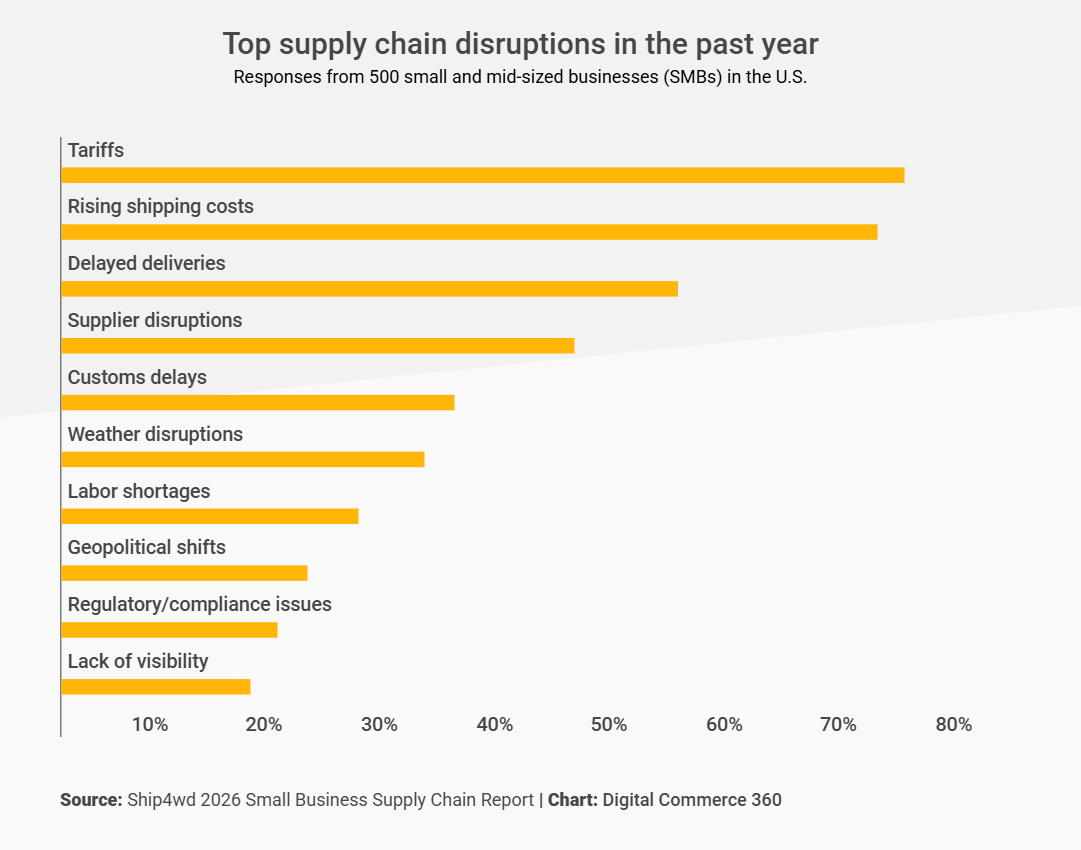
2026 is a convergence of economic threat vectors. [4] The Strait of Hormuz closure in March triggered an energy shock still rippling through every layer of physical commerce. Sweeping U.S. tariff regimes have installed a hidden consumption tax on domestic businesses.
Over a trillion dollars in commercial real estate and private equity debt is maturing under interest rates that make refinancing mathematically devastating. [5] Global supply chains are fracturing at the sub-component level. Consumer spending is decelerating under a record $18.8 trillion household debt load. Traditional banking channels have retreated from the real economy at the exact moment businesses need liquidity most. [6]
Corporate and SMB Sentiment
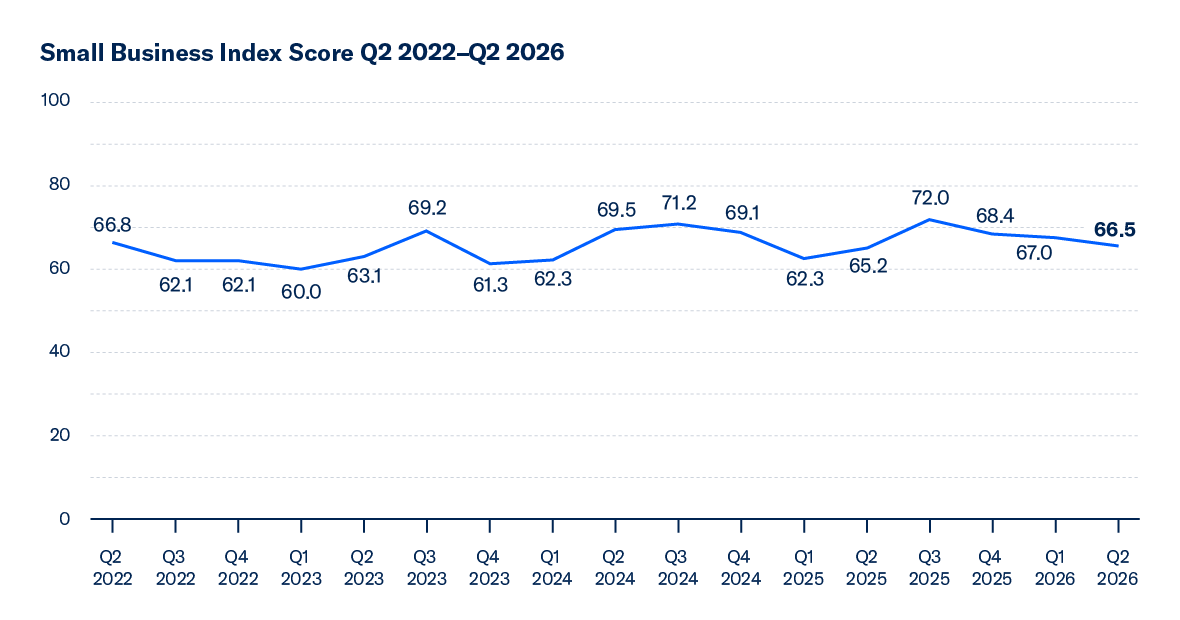
Small and mid-sized businesses across North America are operating in a defensive posture. Conserving cash and holding on expenditures is the pattern. This is driven by uncertainty in the macroeconomic and geopolitical landscape, not by a lack of demand. [7] The feeling manifests like a slow season, but it isn't one. It's a mixture of supply-side slowness and demand-side volatility. [8] Demand is ongoing. The uncertainty is what lowers confidence.
The Labor Paradox
Unemployment and labor cost are rising at the same time. Artificial intelligence has displaced junior, entry-level, and data-organization roles over the past few years. [9] Machines automate mundane tasks and provide operational reasoning at scale. At the same time, labor cost for senior positions and rare technical talent in manufacturing, trades, and technology is climbing. [10] A wider talent pool exists on paper. The talent that actually matters is scarce. This scarcity drives up cost, and it amplifies the difficulty of running a business, because training an unskilled hire from scratch takes time and energy the business doesn't have slack for right now.
The Innovation Arbitrage
Most businesses have already integrated AI into their infrastructure, whether that's a CRM, an ERP, or an internal workflow tool. The barrier to entry for digital creation has collapsed. An average business owner can build a working prototype in weeks and bring on an engineer to strengthen it from there. The speed and cost of creation have both dropped. [11] This lowers the entry barrier for digital creation and amplifies the businesses who choose to capture it strategically.
Demand Persistence vs. Supply Discrepancy
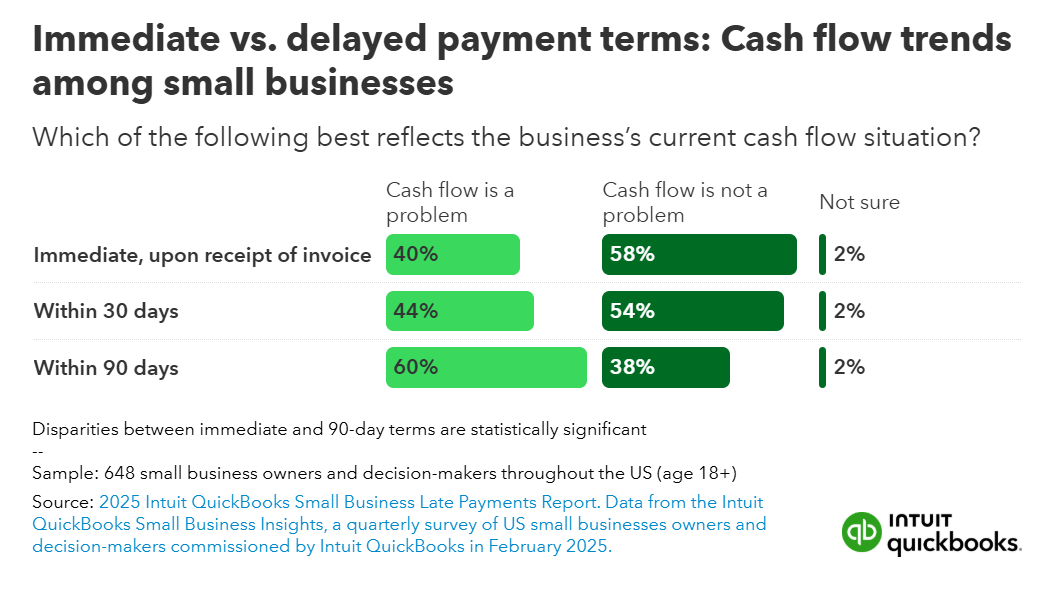
Demand might contract at the margins from unemployment, inflation, and geopolitical disruption. Most people are still employed. The global economy is still growing. Over a hundred trillion dollars circulates every year, and that number is growing too. [2] Demand is not the issue. Money will still flow. The issue is supply-side discrepancy, driven by energy shocks, sub-component shortages, tariffs, and delays that hit a company's cash flow. Demand fulfillment is what businesses should worry about. Take care of the supply side and you capture the demand that isn't going anywhere. It just changes hands, from the companies who can't fulfill it to the companies who can.
Threats and Opportunities
The threats are delays and cash flow timing issues caused by ongoing economic and geopolitical disruption. That strain is what forces companies to forfeit clients. That forfeiture is the opportunity. Buyers who lose their vendor will look for alternatives, whether they're everyday consumers, businesses, or the government. [12] Demand will flow to whoever repositions and strengthens their infrastructure to receive it.
Risk and Strategies
The core risk in this environment is being unaware. Unawareness is where the anxiety lives. Clarity on what's happening, why it's happening, and how to reposition is usually enough to build a base understanding. The second risk is execution, and execution risk depends entirely on real-time adaptability and risk management, whether you're playing defense or offense. The third risk is margin of error. Disruptions and inconsistent demand strain a company from within even when cash flow looks stable on paper, because the timing of revenue coming in against cost going out is what actually breaks a business. Mitigating this is situational. It depends on your current stability, your infrastructure, and your goals. The frameworks ahead give you the tools to manage the downside and see where the opportunities are.
Section II | Risk Management
The foundation of any business operating in this environment is protection first. Offense without defense is just controlled bleeding at a faster pace. This section gives the frameworks to diagnose where you stand, and the specific strategies to protect what you've built before anything else becomes relevant.
Situational Awareness I | Insolvency vs Liquidity
General Overview
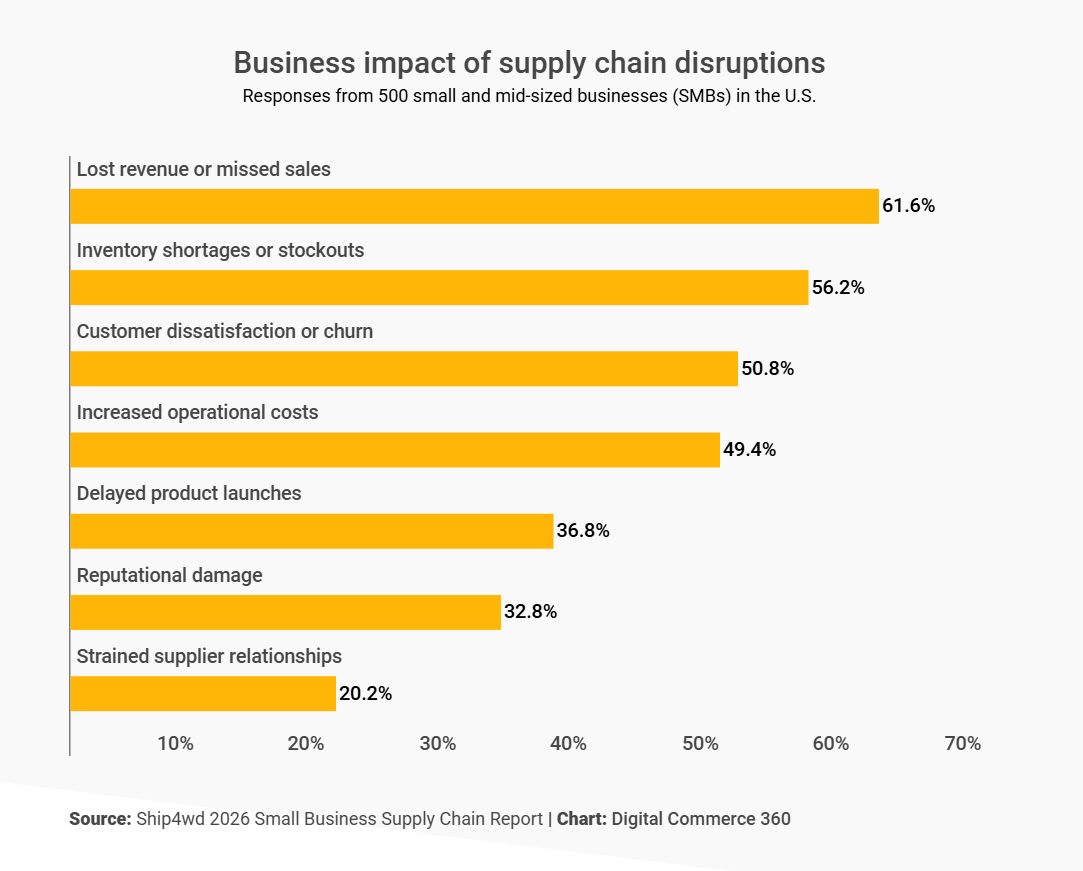
Insolvency and illiquidity are two different problems. Insolvency means liabilities exceed assets. Illiquidity means cash isn't available when obligations are due. A business can be profitable on paper and still collapse from illiquidity. [13] Most operators confuse the two and underestimate the second one until it's already a crisis.
Cash Flow Deterioration
Deterioration happens gradually, then suddenly. Ask whether the decline is driven by falling demand or rising cost. If revenue holds steady but cost eats the margin, the business model is still viable, and tactical adjustment is what's needed. If revenue drops at an unsustainable rate while cost stays fixed, that's a volume problem, and it demands structural restructuring, not a price tweak. Cutting cost or raising prices sounds simple. Executing it without damaging the business or alienating buyers is not. Test tactics in real time, keep the ones that work, and treat this as a controlled experiment.
Cash Flow Timing
Timing delays used to be rare, once or twice a year in a stable market. In this environment they're common. A buyer delays payment or a supplier misses a delivery, and the cost of operations keeps running regardless. The question is whether the liquidity buffer can absorb that gap. Without it, a profitable business can collapse from a temporary lag. Know your cash position and your cash flow separately. Both matter, but knowing exactly where your specific vulnerability sits is what lets you build the right defense instead of a generic one.
Situational Awareness II | Infrastructure Reinforcement
General Overview
Infrastructure is the process, the technology, and the hardware that runs the company day to day. It's where all the data touches and gets organized so leadership can see reality and make decisions on it. Every company can reinforce this differently. The question is whether it's done in a way that strengthens the company without stripping its soul out.
Human vs Machines
AI is powerful and limited at the same time. Large language models simulate the probability of an answer. They can be confident and wrong. Automating everything to cut cost is a trap, because AI should amplify people, not replace them. Machines are strong at mundane, repetitive work that doesn't need sleep. People are strong at identifying problems and solving them once time is freed up. Companies that lay off their people and automate everything will see their innovation pipeline shrink, because models trained on existing patterns circulate in a closed loop. Margins go up short term. Competitiveness goes down long term. [14] Companies that evolve alongside their people, freeing up time for higher-value work, keep both the cost discipline and the creative edge.
The Premium Value of Authenticity
As automation spreads, human authenticity becomes more valuable. People do business with people they like. Human intuition vets whether a customer or vendor is legitimate. The only exception is critical infrastructure, where the buyer has no choice regardless of who's on the other end. Everyone is using AI for something in their business right now. The differentiator isn't whether you use it. It's whether the human touch is still present where it matters, because a client who feels like they're only talking to a machine is a client who's easier to lose.
Data Organization and Decentralized Evolution
Automation and data organization give leadership a real-time, centralized view of the company. This is where AI genuinely shines, but it still requires human oversight. Removing that oversight is not an option. Whether a company values cost-cutting, culture, or evolution will determine what it does with the time this frees up. The companies that let their people identify and solve problems with that spare time, rather than just cutting headcount, build a decentralized innovation engine that compounds over time.
Strategic Balance and Adaptability
There's a limit to how much can be automated before it erodes the company. There's also a limit to how much innovation a limited budget can fund. Finding the right harmony between human authenticity and machine automation is what separates a company that evolves from one that erodes. There will be growing pains. What comes out the other side is a stronger infrastructure and a team more capable of building solutions on their own, with institutional knowledge that survives someone leaving, retiring, or getting poached.
Situational Awareness III | Network Development
General Overview
Network development across buyers, suppliers, and capital is the ultimate hedge against turbulence. It hits the fundamentals of commerce directly: supply, demand, and liquidity. It takes time to build, but current technology means trust can be strengthened through competence faster than it used to.
Buyer Network Expansion
In stable times, networking is a nice-to-have. In turbulent times, it's how you hedge. Buyers in need of alternative supply will come to whoever signals readiness and preparedness. If you don't have a buyer network outside your current base, you can't capture that traffic when it shifts. For consumer businesses, this looks like attention, virality, and community with related companies. For enterprise buyers, it's centers of influence, because enterprise trust is earned through referral arbitrage, rarely cold outreach. A trusted advisor vouching for you lets you borrow their trust while making them look good for the referral. For government, it's the same logic through procurement officers, where the goal is simply being one of their backup vendors before you're needed.
Supplier Network Expansion
If your supplier has a shortage or delay, that delay becomes your delay, and it hurts your reputation with your own buyers. Build two types of supplier networks. First, critical alternatives, meaning backups for whatever part of your supply chain is most exposed to disruption. Second, domestic supply chains, mapped out in advance even if they cost a premium, so they're ready instead of being a scramble. Specifications and quality control matter more than trust alone when vetting a new vendor, because a wrong replacement part is its own kind of disruption.
Capital Network Expansion
Capital access isn't important until it's extremely important. Most companies don't think about credit until they need it, and by then they're negotiating from weakness. Today's banking environment makes this worse for employer businesses. They are seen as risky, resulting in heavy collateral requirements and long wait times. Private credit and specialty finance exist outside that bottleneck. This network matters because when a buyer delays or a supplier delays, operational cost doesn't stop, and liquidity is what keeps the cycle moving. Quality is the main factor here, one strong dealmaker is better than 100 brokers selling the same thing. Access to capital paired with a real understanding of how to deploy it, and whether the resulting debt is sustainable against your cash flow, is what lets a company play risk-adjusted offense instead of pure defense.
Risk Management I | Operational Rhythm Against Delays
Risk Management Overview
Every company has a rhythm to how it interacts with the market. In a stable environment, that rhythm holds, and data flows predictably enough. In this one, delays from both the buy side and the sell side break that rhythm, and a broken rhythm forces a company into a reactive state.
Problem Scenario Identification
A reactive company makes decisions on limited information under real-time external pressure, and that combination increases the odds of a rash, emotionally-driven call. Fixed operational overhead doesn't pause for a disruption, so any delay in capital inflows compresses cash immediately. In practice this shows up as a buyer stretching payment terms or going quiet, a supplier delaying because of a component shortage, supplier’s logistics bottleneck, an internal failure like equipment breaking, or a critical employee leaving without warning. None of these alone is fatal. Stacked together against rising input cost, the margin for error disappears, and that convergence is the exact point where a company shifts from vulnerable to distressed.
Solution Protocols
The fix is timing mechanics and liquidity circulation, built before the disruption hits, or as soon as possible.
Supply-Side Simulation. Quantify the exact weekly cost of a primary vendor going dark. Model what a one-week, one-month, or four-month freeze costs in cash, scaled to how exposed your specific supply chain actually is to international logistics.
Demand-Side Simulation. Model the impact if receivables slow by 30 to 60 days, or if top-line revenue drops because buyers pull back. Isolate the exact cash-burn number required to sustain fixed overhead until revenue cycles back to normal.
Liquidity Buffer Sizing. Once you know the burn rate, you know the size of the buffer you need. Fund it internally if your reserves support it, or anchor it through a credit facility if they don't. Using your own cash to patch every disruption drains your reserves over time and leaves the core business unhedged the next time something breaks. A credit buffer, secured while your balance sheet is strong, protects that cash instead of spending it down, but is anchored towards the cash flow.
This is exactly what large conglomerates do. They secure asset-backed lines, unsecured term debt, or flexible credit mapped to their cash flow, purely to shield their own cash. Their revenue is massive and their fixed cost is massive too, so their liquid cash is thinner than people assume relative to what they owe. The logic holds at any size: if your cash flow can anchor a credit buffer, get it now, because private credit markets get far more restrictive the moment your operation shows volatility. Waiting until you need it means negotiating from weakness.
Core Principles in Execution
1. Map disruptions from both the supply and buyer side and know your runway before liquidity runs out.
2. Calculate the liquidity cycle needed to maintain vendor payments and fulfillment through a timing freeze.
3. Stress-test what happens if multiple disruptions stack at once, a supplier fracture at the same moment a major buyer defaults, and know your actual breaking point.
4. Prepare cash or secure the credit buffer while you're strong, not after volatility shows, since that's when terms get worse.
5. Then execute the protocol the moment disruption hits instead of scrambling to build one in real time.
Risk Management II | Inventory Hedging Against Shortages

Risk Management Overview
This tactic is stocking up on inventory to protect against shortages or inflation, either by stockpiling critical inputs exposed to global disruption, or by bulk purchasing to freeze costs against rising inflation. [15] During prolonged instability, physical inventory becomes worth more than cash. This is the same hedging logic commodity traders and tier-one factories use to lock in pricing and fulfillment before the shortage actually hits.
Problem Scenario Identification
Global manufacturing is tightly nested. Subcomponents feed subassemblies, which decide whether the finished product exists at all. Energy shocks and tariffs raise the cost of basic inputs, and companies pass that down the chain to survive. A shortage is worse than inflation, because inflation compresses margin while a shortage kills revenue outright. Buyers won't settle an invoice until delivery happens, and a missed delivery triggers penalties or lost contracts. The failure point is almost never your most expensive material. A two-dollar plastic mold out of a rationed facility in Southeast Asia can ground a five-hundred-dollar finished product. This exposure runs through electronics, chemicals, metals, and fabrics alike. An inventory hedge removes dependence on just-in-time logistics and keeps production running regardless of what's happening upstream.
Solution Protocols
Supply Chain Mapping. Audit your procurement down to the component level and identify every part exposed to cross-border shocks or maritime chokepoints. Criticality doesn't track with cost. Rank each input on exposure to trade friction, availability of a local alternative, and how much veto power it actually holds over fulfillment. AI tools and industry pattern recognition can map this in hours, not weeks.
Inflation Forecasting. Stress-test your inputs against domestic tariffs and rising utility or petrochemical cost. Storage isn't free, so run the real math: is it cheaper to absorb price volatility as it comes, or lock in current rates through bulk procurement now. If a material shows high volatility risk, treating the bulk buy as a financial hedge, the same way commodity markets do, freezes your cost structure while competitors eat the increase.
Domestic and Regional Redundancy. Pre-qualify an alternative, geographically insulated vendor before the crisis, not during it. Vetting a backup supplier is a specifications and quality-control exercise first, trust second, because a mismatched part creates its own disruption. Once alternatives are verified, the hedge runs on three tracks: a stockpile of vulnerable components with your current vendors, a bulk buy to counter inflation, and a rolodex of pre-qualified backups ready to activate.
Funding this requires real upfront liquidity. Burning your own cash to build the buffer drains the reserves you need for the next receivables lag. Unless abundant in cash, a structured credit line, an asset-backed loan or private credit facility tied to your balance sheet can fund this hedge while keeping raw cash free in cases of emergencies or opportunities.
Core Principles in Execution
1. Map your components and rank each by trade exposure, alternative availability, and criticality to fulfillment.
2. Simulate a 10, 25, and 50 percent cost spike against your cash flow and factor in storage cost to find where bulk buying beats absorbing the hit.
3. Pre-vet alternative suppliers on specifications now, so the transition is friction-free when it's needed.
4. Decide whether cash or credit funds the position, anchored to what your balance sheet can actually sustain.
Done right, this turns supply readiness into a localized monopoly over the demand your unprepared competitors can't fulfill.
Risk Management III | Technological Upgrades Against Data Entropy
Risk Management Overview
Data entropy is disorganization, and it should be the first thing eliminated inside the organization. The technology to fix this is a fraction of what it cost a decade ago, which means there's no excuse to keep operating blind.
Problem Scenario Identification
External uncertainty plus internal disorganization compounds fast. In stable times, fragmented data across sales, fulfillment, and finance doesn't matter much, because margins are wide and demand is predictable. In this environment, real-time clarity is priceless, because it's what lets leadership spot the pivot point instead of reacting a week late. [16] A company running siloed systems watches a factory shutdown in Asia and a diplomatic headline in the Middle East and reacts emotionally, because they can't see their own exposure clearly enough to respond with logic instead of fear. Overseas production dependency compounds this, since it hands core capability to infrastructure you don't control. And without digital and physical data actually talking to each other, fulfillment accuracy erodes right when precision matters most.
Solution Protocols
System Blueprinting. Treat the company as one interconnected structure, not separate departments. Sales, marketing, finance, operations, and people are all structurally dependent on each other whether the org chart shows it or not. Isolate the exact metrics each department needs to stay aligned top to bottom. This step costs nothing but a whiteboard, the team, and honesty about what's actually happening. Document it. This becomes your first real operating system.
Reshoring as an Infrastructure Hedge. Whether to bring production in-house depends on your product and your existing buffers. Stockpiling raw components does nothing if final assembly still happens overseas and that facility loses power. Where the unit economics work, a lean domestic equipment stack, not a full factory, is enough to clear your own production quota and insulate against the overseas dependency entirely.
Real-Time Data Infrastructure. Once metrics and manufacturing exposure are mapped, build the system two ways. Vibe-code a prototype internally using AI if speed matters more than long-term scale, understanding this creates software debt if the team isn't technically literate. Or bring in a fractional CTO or engineering firm if the infrastructure needs to be defensible and built to last. Either way, the goal is one centralized dashboard that shows leadership the real state of the company in real time.
Core Principles in Execution
Map every workflow across sales, marketing, finance, and logistics into one visual structure and document it as your operating system. Trace the manufacturing origin of every outsourced component and identify what domestic equipment would neutralize that exposure. Build the data infrastructure, whether internally with AI or through a hired engineer, prioritizing accuracy over speed if the two conflict. Capital cost here stays low outside of physical equipment. Done right, this gives leadership a clear, unblinded view of the company that sharpens every decision that follows it.
Risk Management IV | Centers of Influences Against Inflationary Costs
Risk Management Overview
Only playing defense in this environment is a mistake. The entire market is anxious right now, buyers, vendors, competitors, all of it. That anxiety creates a vacuum where everyone is actively hunting for a signal of stability. This tactic hedges against inflation by expanding your demand network, because the only sustainable way to fight inflation is more revenue from a wider, prepared base, not tighter margins.
Problem Scenario Identification
Cost will keep inflating regardless of what any single company does, driven by tariffs, maritime logistics fees, war-risk insurance, and energy spikes. A company on pure defense faces a binary bad outcome: absorb the inflation and watch margin erode, or pass it downstream without a buyer network wide enough to hold the pushback. Anxious buyers switch vendors fast, even to an alternative charging more, the moment a single delay happens. Without a demand network already built, a company gets hit twice: once by the inflation itself, and once by the buyer who leaves the first time something goes wrong.
Solution Protocols
Mapping Centers of Influence. Identify who actually controls access to your buyer base. For consumer businesses, that's creators, brand partnerships, and consortium-style community models. For B2B, that's distributors, industry consultants, and independent brokers who already hold institutional trust. For government, that's procurement officers and trade association contacts. In B2B and B2G specifically, these gatekeepers are driven by downside protection, they need certainty of fulfillment more than anything else, so build the relationship around solving that for them.
Engineering Value to Trigger Reciprocity. Once the COIs are mapped, build something genuinely useful, a blueprint, a risk framework, sector-specific intelligence, and give it away free instead of gating it. This isn't a soft tactic. It's how competing tribes built alliances throughout human history, through gifts and demonstrated goodwill before any transaction happened. Inside that value, embed a clear signal that you're ready and prepared, without making it read like a pitch. The COI should feel like they found a hidden asset in their network, not like they got sold to.
Continuous Network Gardening. Show up consistently across LinkedIn, trade events, and industry conferences. Give generously without giving away your actual operational leverage. This is gardening, not a campaign. The quality of what you give determines how strong the seed is, and a well-vetted network compounds into real revenue over time instead of one-off wins.
Core Principles in Execution
1. Map your centers of influence by sector, consumer, enterprise, or government, and understand what each one actually needs from you.
2. Build incentives that are genuinely mutual, not just self-serving, and embed your readiness signal inside the value itself.
3. Launch outreach through whatever channel fits the audience, adjusting the script per contact while keeping the underlying framework consistent.
4. This costs very little beyond the time to build the value piece and stay consistent.
The return is asymmetrical against the cost, because the entire point is widening your surface area of demand so inflation has fewer places left to erode you.

Section III | Hidden Opportunities
Risk management is the foundation. This section is the offense that becomes possible once that foundation is real. Playing only defense in this environment protects you from disruptions or bleeding out, but it doesn't grow the company. Genuine opportunity exists right now for those who prepared, and none of it is available to those who didn't.
Situational Awareness I | Operational Readiness
The Price of Readiness
Before chasing forfeited demand from unprepared competitors, the internal infrastructure has to be able to hold it. Developing a buyer network and landing more contracts than you can fulfill means you either decline the work or take it on and watch quality slip right when everyone's watching closest. More demand isn't the problem. An unpatched leak is the problem, and a small leak on a small ship is manageable. The same leak on a bigger ship sinks it. Readiness looks different for every business, whether that's a liquidity buffer, inventory, new production capacity, or stronger data infrastructure, built in parallel with the buyer, supplier, and capital networks already discussed. Which holes get patched first is a leadership call, but it has to happen before the demand shows up.
The Cost of Unfulfillment
Chasing forfeited demand before protecting the downside is the inverse mistake. A company that overreaches past its threshold fails to deliver, and failure to deliver when you didn't need to take the client in the first place is a worse position than never taking it at all. Money doesn't buy a resilient supply chain on demand. That takes time, capital, and real execution. Taking on new clients without downside protection means a single disruption turns into reputation damage, liability exposure, and an operational rhythm break at a scale the company wasn't built to absorb. The more responsibility you take on unprepared, the harder the weight comes crashing down when something breaks, and something always breaks eventually.
Urgency vs. Rushing
Urgency is knowing exactly what needs to happen and doing it at maximum speed without cutting corners. It's proactive. It protects the standards and vetting that keep a company solvent, because there's still time to gather information and make the right call. Rushing looks identical from the outside but comes from a different place entirely. It's what happens when a company is already reactive from distress, and it compounds bad decisions instead of preventing them. Rushing builds operational debt through small compromises on quality that don't show up immediately but show up eventually, usually at the worst time. A proactive company protects its downside while it still has the freedom to choose. A reactive company is stuck cleaning up the consequences of decisions made under pressure. Operational readiness is the physical proof that a company is the former, and it's what determines whether new opportunity strengthens the business or breaks it.
Situational Awareness II | Network Surface Area
Quantity and Quality of Network
Network surface area runs on two tiers, and both matter. Quantity is the number of contacts in your access pool, the people you know at a surface level who expand your optionality and your odds of catching an opportunity at the right moment. Quality is the smaller group you actually do business with, the ones who've earned trust and become your execution arm. Quality doesn't come first. It's a byproduct of expanding quantity, because you find your best vendors, buyers, and capital partners inside the wider pool you didn't know existed until you started meeting people. Neither tier replaces the other. Quantity builds the odds. Quality builds the execution.
Covering Blindspots through Access
Consistently building this network across buyers, suppliers, and capital means physical access to alternatives when you need them, and the only thing separating you from that access is a phone call or an email. That speed is the entire advantage. Competitors without this network spend their time searching and vetting from scratch while you're already moving. Building it doesn't take years. One new contact a day, five days a week, is over twenty new connections a month, and that consistency compounds faster than people expect. The capital layer runs on quality over quantity, since one strong dealmaker beats a hundred lenders pitching the same product. The buyer and supplier layers run on quantity, since knowing who has what at the moment you need it is what actually cuts through the fog.
Compounding Returns on Connections
Every new relationship carries individual expertise, pattern recognition, and access that compounds over time. Building these connections takes authenticity, curiosity, and genuine confidence in your own competence, and that combination is what makes people want to keep talking to you. What comes back is ideas, access, and intelligence you couldn't have generated internally. This is where skill transfer actually happens in business, through conversation, not training manuals. The company gets stronger because the operator gets stronger, and that's a compounding return no single transaction can match. Networks aren't built overnight, but one connection can change everything overnight, so the discipline is showing up consistently and staying open, not chasing a shortcut that doesn't exist.
Situational Awareness III | Liquidity Strategies
Capital Resource Allocation
Capital comes in two forms, cash and credit, and both function as purchasing power. Cash is the backdrop of the company. Without it, distress becomes existential. Credit is debt that has to be repaid, and it doesn't carry the same freedom cash does, even though it functions the same way in the moment. Think of cash flow as a river and cash reserves as the pool that river fills. A volatile river slows the pool's growth. A pool that's constantly drained by rising cost puts the company in distress even with a strong river feeding it. Credit is anchored to that river's stability, since debt service comes directly out of cash flow. A cash flow problem is a strategy problem and can be fixed. A cash reserve problem restricts freedom directly and is far harder to reverse.
Organizational Relevance
Building a real liquidity strategy means understanding what the company actually needs it for, defense, offense, or just sustaining operations, and that determines every allocation decision that follows. Whether credit makes sense depends entirely on cash flow stability, since debt with unstable cash flow just becomes a drain. Credit only makes sense for two reasons: strengthening risk mitigation or capturing hidden opportunity. Lenders price terms based on how strong the business already looks, so a strong company gets better terms and a weak one gets worse ones, which is exactly why the timing of securing credit matters as much as the decision to get it.
Offensive and Defensive Structures
Capital itself is neutral. What makes it an advantage is positioning, and positioning is what increases the odds that preparation actually meets opportunity when it shows up. Defense always comes first, because a glass cannon breaks on first contact while reinforced concrete survives for decades. Defense is what keeps a company alive long enough for offense to become possible at all. Liquidity spent on operational buffers, inventory, or infrastructure builds that resilience. Offense, capturing forfeited demand, increasing sales aggressiveness, positioning in the buyer's mind, is the natural byproduct of a company that already survived the hard part. Liquidity is the bridge that makes execution possible either way, and whether that bridge is built from cash or credit depends entirely on the strength already discussed above.
Hidden Opportunities I | Demand Capture
Opportunity Overview
Competitors will forfeit demand during this environment, through delays, shortages, and cash flow strain that isn't their fault so much as it's the market's fault. That forfeited demand doesn't disappear. It transfers to whoever is positioned to receive it. The buyer still needs the product or service. They just can't get it from the vendor they've always used, and they're not going to wait around indefinitely while that vendor figures itself out. This window stays open for years even in a best-case scenario, because rebuilding broken infrastructure, renegotiating deals at a geopolitical level, and regaining trust with the business community all take real time. Even a full resolution overnight doesn't undo the multi-year lag it takes for supply chains and institutional relationships to actually normalize. That lag is the opportunity window, and it's wider than most operators assume.
Why the Prepared Are Favoured
Buyers seek stability during a period of low trust and high unpredictability, and they'll pay a premium for it. When a competitor forfeits demand, the buyer eventually loses patience and moves, and the market, like gravity, finds whoever's prepared. But the truly prepared already planted the seeds before the competitor's failure happened, through liquidity buffers, stocked inventory, stronger production, and the networks already built. Preparation here isn't reactive. It's a standing posture, built in advance of the exact moment it becomes useful, which is what separates the company that captures the demand from the company that just watches it pass by.
Rewards for the Prepared
The reward is increased revenue, the ability to command premium pricing in a seller's market, and a reputation boost that compounds through word of mouth. Trust that takes years to build in a stable market builds in weeks during a disruptive one, because relief from finally getting fulfilled creates an emotional response that accelerates loyalty. A buyer who was stranded and got rescued talks about it differently than a buyer who just had a normal transaction. That gratitude becomes referral, and referral becomes the next round of demand without any additional cost to acquire it. Captured correctly, this window becomes an accelerator that compresses years of growth into a much shorter window, effectively letting a prepared company skip several stages of organic scaling that it would've otherwise had to earn slowly.
Risks, Requirements & Responsibilities
Demand capture isn't guaranteed even when the odds favor you. New demand comes with less patience than a legacy client relationship, since a new buyer's trust is thinner and easier to break, and if that trust breaks, word travels through their network too, not just yours. Requirements are straightforward but non-negotiable: a real buyer network, operationally sound infrastructure, honest expectation-setting instead of overpromising to close, and a liquidity buffer ready for when something inevitably goes wrong during the push. Leadership's responsibility is being clear-eyed about capability and committing fully to whichever path, offense or conservatism, actually fits the company right now.
Core Principles in Execution
1. Audit financials, operations, and people to understand real capability before committing.
2. Decide with the team whether pursuing forfeited demand is worth the operational investment required, or whether staying conservative is the smarter move for this specific company.
3. Line up network development and data infrastructure in parallel. Get the team aligned on the direction, because aligned action compounds and scattered action doesn't.
4. Then build the actual outreach, centers of influence, value anchors, consistent networking, and let the data and your own intuition tell you what's working.
Risk-Adjusted Opportunities II | Government Contracting
Opportunity Overview
Government spending rises during economic turbulence to stimulate circulation, and the Pentagon's new $1.15 trillion defense budget, up roughly $300 billion from the prior cycle, is a real demand source on its own. [17] The federal government buys almost everything under the sun, physical goods, logistics support, cybersecurity, and general operational supplies. It has a reputation as an exceptionally strong, reliable buyer that doesn't disappear during a downturn the way private demand can. In this environment, the vendors who are prepared and stable win contracts against legacy vendors who aren't, and that shift is happening faster than most operators outside the space realize. Supply-side disruption is hitting legacy government contractors just as hard as it's hitting everyone else, and a legacy relationship with a procurement office doesn't protect a vendor who can't fulfill.
Why the Prepared Are Favoured
Procurement officers carry real consequences for delay and unfulfillment, including their own job security, which makes them heavily favor stability over the lowest price. They're willing to pay a premium for a vendor who can actually deliver, because the government can't manufacture a domestic supply chain overnight even with policy pushing reshoring. Legacy vendors who can't fulfill get switched out more easily in this climate, which opens the door wider for prepared alternatives who might not have any prior government contracting history at all. A clean compliance record and a demonstrated ability to deliver matters more right now than years of incumbency.
Rewards for the Prepared
A government revenue stream is one of the most stable a company can access, largely because it doesn't contract the way consumer or even enterprise demand does during a downturn. Reputation compounds with procurement officers once you've delivered, since a track record inside one agency tends to travel to others through the same professional networks. Pricing power increases because the government values reliability over rock-bottom cost, and once trust is established, contract size and volume both tend to grow without the aggressive courting a commercial buyer requires. In practice, this often means the first small contract becomes the foothold for a much larger, recurring relationship, since procurement officers strongly prefer expanding with a vendor they already trust over vetting a brand new one from scratch.
Risks, Requirements & Responsibilities
Failing to fulfill a government contract carries real consequences: penalties, contract revocation, or a multi-year suspension. Compliance and cybersecurity infrastructure is the barrier to entry, and it costs money upfront with no guarantee of a contract landing. Payment cycles also run long, often Net 60 or more, which strains liquidity if it isn't accounted for. Requirements are operational risk management, compliance infrastructure, a liquidity buffer for the payment lag, and someone dedicated to running this division so it doesn't bleed into the rest of the business. Responsibility means bidding honestly, keeping compliance current, and being transparent with procurement officers the moment something threatens fulfillment.
Core Principles in Execution
1. Map current capabilities and risk exposure first.
2. Research which contract types actually fit the business. Understand the compliance requirements and what they cost to clear.
3. Audit with the team whether the investment is worth it against the likely return.
4. Build the risk management and compliance infrastructure in parallel, then move into bidding once both are solid, staffed by either an internal operator, a hired specialist, or a contracting broker.
Hidden Opportunities III | Infrastructure Sharing
Opportunity Overview
When supply is short and demand holds, whoever has the abundant supply gets to dictate the transaction. If you're sitting on stocked components a competitor desperately needs, you can lease it, revenue-share it, profit-share it, or trade it for equity. You become their lifeline, and a company that needs something to survive will pay far more than the open market price to get it. This isn't a hypothetical scenario dependent on rare conditions. It's the natural byproduct of doing the inventory hedging work already covered in Section II. If that hedge was built correctly, this opportunity essentially falls out of it for free, since the excess capacity was already sitting there, only used defensively until now. The shift is simply choosing to view that surplus as an asset instead of just insurance.
Why the Prepared Are Favoured
Those with physical resources have structural leverage because their fulfillment capability is resilient when everyone else's isn't. Money can buy a component at a higher price, but money can't buy a component that simply doesn't exist right now. The company that already has it stocked before the shortage hits is the one holding all the leverage in that negotiation, and that leverage doesn't fade quickly, because rebuilding a broken supply line takes the disrupted competitor real time even after the shock itself passes.
Rewards for the Prepared
The reward is negotiating leverage and, often, an asymmetric return on a relatively small initial investment. Stock a year's worth of a five-dollar component that a competitor needs for a five-hundred-dollar product, and a five percent revenue share nets a five-times return on that unit cost. A profit share structured differently can land in the same range depending on the competitor's margin. The upside isn't really the price point. It's that your own operation stays hedged while the option to profit off spare capacity remains entirely optional, and that optionality is worth something on its own even in years where you never actually use it, because the moment it's needed, it's already built.
Risks, Requirements & Responsibilities
Not every component carries this leverage, only the ones genuinely critical to another company's supply chain during a real shortage. Overextending your own supply to chase this upside is the core risk, since you don't want to compromise your own operation to profit off someone else's. Contracts here are niche, revenue share, profit share, or equity terms all require real legal structuring, and payment enforcement needs to be airtight from the start. Requirements are a clear read on what's actually critical, disciplined math on how much you can lease without overextending, proper legal paperwork, and due diligence on whoever you're partnering with. A low-integrity partner turns an asymmetric opportunity into an operational headache. It's never an obligation to allocate. Protecting your own downside always comes first.
Core Principles in Execution
1. Identify what's worth stockpiling based on criticality and vulnerability, not just cost.
2. Calculate how much surplus you can hold before it strains your own operation.
3. Get the legal and logistics infrastructure in place before offering anything to a competitor.
4. Plant the relationship seeds early through the buyer and supplier network already built, signal that supply exists, and let the opportunity activate itself when a competitor's disruption actually hits.
Hidden Opportunities IV | Distressed Acquisitions
Opportunity Overview
Businesses that were genuinely strong before this environment are weakening under it, and some are heading toward forced sale or liquidation. [18] That's an opportunity for whoever has the cash, the industry expertise, and the data infrastructure to acquire them, because these aren't bad companies. They're good companies caught unprepared. A business that would've sold at a three to five times multiple a few years ago might sell at two to three times now, both because the multiple compresses and because the seller is emotionally worn down enough to accept it. This is a different opportunity than the others in this section, since it isn't about capturing demand or leveraging surplus. It's about acquiring the entire operation, the team, the client base, and the infrastructure, at a discount that only exists because the seller ran out of runway before the market turned back in their favor.
Why the Prepared Are Favoured
Prepared buyers have the liquidity, inventory hedge, data infrastructure, and network already built, which means they can actually close and integrate successfully instead of just window-shopping distressed listings without the capital to follow through. The math favors them too, since the seller's depressed cash flow and lower trailing EBITDA justify a lower multiple, and the seller's exhaustion makes them more willing to accept it than they would've been a year ago. Owner-led buyers hold a real edge over pure institutional buyers here, because they understand the operational reality of running a business under pressure, and that instinct, knowing what a business actually needs to stabilize versus what looks good on a spreadsheet, is harder to replicate than financial engineering.
Rewards for the Prepared
The reward is expanded capability, talent, data, clients, brand, and infrastructure, acquired at a discount. For institutional buyers this often means a roll-up or bolt-on strategy, stitching together fragmented assets for a future exit. For owner-led organizations, it means real verticalization or complementary capability added directly into the existing operation, compressing years of organic growth into a single integration. A business that would've taken years to build from scratch, an established client base, trained staff, working infrastructure, can be absorbed in a single transaction, which is the entire appeal for an operator who already has the internal bandwidth and stability to take it on.
Risks, Requirements & Responsibilities
Integration is where most of the real risk lives, not the acquisition itself. Cultural misalignment, inherited liabilities that don't show up on a spreadsheet, undocumented processes, and leverage taken on to fund the deal can all turn a good acquisition into a bad one if the diligence isn't thorough. Requirements are the operational capacity to actually onboard a new business, deep diligence that goes beyond the financials into culture and staff, and a real integration plan that keeps existing leadership in place long enough to avoid destabilizing the team. The responsibility is building the deal flow yourself, vetting rigorously, and owning the outcome of the integration completely, since a poorly integrated acquisition can drag the acquiring company down instead of strengthening it.
Core Principles in Execution
1. Strengthen your own downside first, since this entire opportunity depends on being the stable party in the transaction.
2. Build the network that surfaces deal flow, whether through relationships or public brokerage platforms. Vet seriously with the team before committing time and capital.
3. Line up financing, whether SBA, seller financing, or private credit, structured to stay sustainable against the post-acquisition financials.
4. Close, then integrate deliberately, setting clear goals and giving the existing team a real voice in what worked and what didn't under the previous ownership.

Section IV | Executive Strategies
Everything up to this point has been foundation and positioning. This section is the synthesis applied to strategies. Take these frameworks as data points to combine with your own judgment and sector experience.
Executive Strategy I | Cash Management & Liquidity Allocation
Overview of Strategy
Capital reserves are the substrate every other strategy in this report depends on. Without structured allocation, none of the defensive or offensive plays already covered are actually executable. A disciplined cash strategy protects liquidity velocity and insulates operational rhythm against delays, shortages, and pricing inflation, whether that liquidity sits in organic corporate cash or a dedicated credit facility. Strategy gives capital its direction, that capital manifests as defense, and strong defense gives leadership the freedom to capture opportunity. Where the opportunities sit depends on the sector, but the market broadly rewards preparation right now. Opportunities through reshoring demand, public infrastructure spending, government contracting, and forfeited demand from unprepared competitors breaking across every industrial sector.
This is relevant to companies with stable cash flow and a downside strategy already in motion. Those companies are the ones positioned to actually see these opportunities as they surface, not just react to them after the fact. Liquidity here isn't a static number on a balance sheet. It's operational oxygen, and it needs to be treated that way. Resource requirements come down to a simple tradeoff: cash if you have abundance, understanding that consecutive disruptions strain the reserve directly and shrink your margin for error going forward, or credit if you don't, understanding that its long-term value depends entirely on how stable your cash flow already is and how well the debt terms were negotiated up front.
Tactic 1 | Operational Rhythm Buffers
This is a liquidity reserve sized specifically to absorb the timing shocks that break a company's operational rhythm (i.e. a supplier delay that halts invoicing, a buyer who slows payment in response). If an upstream supplier freezes production for two weeks over a routing delay, the firm can't deliver or invoice. If the downstream buyer simultaneously stretches their own payables to conserve cash, that timing gap turns into real capital strangulation fast. Building this buffer means simulating the real cost of a disruption, isolating fixed monthly cost, then calculating exactly how much cash a two-week, one-month, or four-month gap would burn against those obligations. Once that number is known, a buffer, cash or credit, sized to it gets locked into a secure account and treated as untouchable outside of an actual disruption. This matters because proactive preparation buys stability before the shock hits, letting leadership price in the cost of disruption ahead of time instead of scrambling for it mid-crisis, and it signals confidence to employees, suppliers, and buyers exactly when that confidence is scarcest.
Tactic 2 | Critical Inventory Stockup
This is a physical hedge against shortages, delays, or inflation on the supply side. Overseas suppliers are under real stress right now from energy rationing and shipping bottlenecks, and even a cheap, low-tier component can halt an entire order if it's missing. North American assembly might look insulated on the surface, but a single missing SKU manufactured somewhere rationed can freeze a finished product indefinitely, turning good inventory into dead inventory overnight. Fixing this means auditing the value chain down to the component level, cross-referencing each part's origin against known trade bottlenecks and grid exposure, then running every input through three filters: how critical it actually is to the finished product, how vulnerable its source is geographically, and whether a domestic alternative exists. This matters because a delayed component postpones the entire shipment regardless of how small or inexpensive it was, and that postponement delays invoicing while operational cost keeps running. Enough of those delays and buyers start looking elsewhere, permanently.
Tactic 3 | Independent Production Capabilities
This is bringing critical component production in-house instead of relying on overseas manufacturing. It's not for every sector, some businesses need it while others don't. But for those heavily exposed to foreign supply chains, this closes the gap directly instead of just managing around it. Execution here means identifying which specific components can realistically be manufactured internally without building an entire factory. Then acquiring a lean, targeted equipment stack (CNC machines, 3D printing arrays, or precision engineering tools), whatever the specific need actually requires, alongside a domestic source for the raw materials that feed it. This matters for the same reason inventory stockup matters. It insulates against overseas instability, except here you control the raw materials and the production timeline directly instead of depending on a supplier to have stock ready when you need it.
Risk & Rewards
Risk: The risk sits almost entirely in the planning phase and the trade-offs that come with it. Leadership retains full autonomy during planning to run diagnostics, vet trajectories, and consult trusted advisors. But every execution path such as calculating buffers, auditing suppliers, evaluating reshoring hardware, runs into real constraints: cash flow that can't fund the expansion, components that are temporarily unavailable, or equipment that costs more than the parts it replaces. Think of the strategy as a container built to hold capital. If that container has structural holes, unverified assumptions, uncontracted vendor relationships, or inaccurate cash flow math, capital leaks out regardless of how good the underlying plan looks on paper. This is a one-way street once executed, so the discipline has to happen before the money moves, and it demands constant maintenance once it's live.
Reward: Deploying these tactics correctly secures real downside insulation and locks in a liquidity buffer that's responsive when something breaks. The reward is operational flexibility during extreme turbulence, because the protocols are already built, the resources are already allocated, and the team isn't improvising under pressure while everyone else is. This clarity becomes a permanent psychological anchor for the firm, and because cash and credit allocations are stabilized ahead of time, offense follows as a natural byproduct of having already handled defense. Capital preservation buys operational time, and that time is what lets leadership acquire hard assets and talent the moment an opportunity opens up, while competitors frozen by the same disruption are still figuring out what to do.
Execution Principles
1. Audit current cash flow, liquidity strength, and supply chain exposure down to the sub-tier vendor level.
2. Run cost-benefit models comparing reshoring against stockpiling and simulate the real balance sheet impact of a two-week to two-month freeze. Synthesize that audit into a defensive roadmap with the team, mapping exact capital allocations to specific risk accounts.
3. Build the offensive expansion plan in parallel, outlining how this reinforced infrastructure gets leveraged once the downside is actually secured. Establish direct contact with alternative suppliers, equipment vendors, and credit sources to get real quotes and terms before committing capital.
4. Present the finalized plan to stakeholders, then execute, placing orders, securing financing, and locking in the response protocols so they're ready the instant a disruption materializes.
5. Once the downside is genuinely insulated, redirect focus toward expansion, scaling sales pipelines and entering counter-cyclical revenue streams, tracking competitor defaults continuously to adapt in real time.
Executive Strategy II | B2C Asymmetrical Marketing & In-House Consortium
Overview of Strategy
B2C companies are dealing with volatile traffic, inflated logistics, and conservative consumers, all of which strain cash flow and break the customer acquisition math that used to work. The fix is leveraging the trust of related, non-competing companies by building a performance-based consortium and running closed-loop marketing between them. This increases the surface area of traffic and sales, gives customers exclusive cross-brand deals, and expands income generation for every company inside the group, all without any single business having to expand its own marketing budget to get there. Opportunities exist across both e-commerce and brick-and-mortar, wherever a cost-effective partnership and a real understanding of the shared customer base can be built. This is relevant to any consumer business with inconsistent traffic and a product that's genuinely complementary to others nearby, since the entire model depends on customer bases that overlap without directly competing. Resource requirements stay low for the core mechanism, which runs almost entirely on networking and negotiation, though building a dedicated retail subsidiary or a proper tracking platform requires targeted capital if the consortium scales beyond informal partnerships.
Tactic 1 | Regional Strategic Partnerships
This is a regional consortium of related businesses cycling the same customer base through performance-based referral incentives, physical flyers, gift cards, or tracking links tied to commission. It works through direct outreach, mapping what your customers already spend on elsewhere, then pitching nearby complementary businesses and structuring the referral incentive around what your customers would actually value from theirs. Commissions get tracked transparently through shared ledger software or a centralized database, so every partner can verify referral traffic instead of relying on trust alone. This matters because it increases surface area and traffic through trust arbitrage instead of paid ads, and because customer acquisition cost drops as the referral cycles between partners instead of resetting with every new campaign the way paid acquisition does.
Tactic 2 | Consumer Brand Consortium
This is a shared retail platform, run as a subsidiary, that aggregates complementary consumer brands under one identity, letting each brand handle its own fulfillment while the platform controls marketing and traffic. It works by targeting the customer archetype rather than individual products, turning the platform into a curated distributor that lends third-party validation to smaller or newer brands who benefit from being positioned alongside more established names. This matters because it increases both the surface area of sales and the brand's own marketing reach, converging customer bases that wouldn't normally cross paths, while every transaction inside the platform functions as a multi-tier revenue stream for the organizer.
Tactic 3 | Consortium Virality Engineering
This is using organic social attention through authority content or entertainment content to drive traffic toward the consortium as a whole, not just one brand. It works through either dropping free, credible expertise that builds trust, a dental practice fact-checking industry myths, for example, or building genuinely entertaining content, a challenge, a day-in-the-life, something with real production value, tied to the partner network across multiple businesses at once. This matters because the cost is minimal and the potential return is asymmetric, since one piece of content reaching the right audience can drive traffic across every partner in the consortium simultaneously instead of just one storefront.
Risk & Rewards
Risk: The core risk is partner integrity, since the whole model depends on trust between businesses that are technically independent and could walk away or underperform at any time. A weak data tracking system, an unclear referral structure, or a partner who mistreats a referred customer all reflect back on you by association, and that reputational contamination travels faster than any individual campaign can outrun. If the technology lacks transparent cross-referencing, attribution errors creep in, and without a centralized tracking system managed by the organizing firm, counterparties can misreport sales volume, which fractures trust and creates real contract enforcement friction across the entire network.
Reward: The reward is a new revenue stream built on asymmetrical, low-cost traffic that compounds over time, since businesses keep running their own marketing while the consortium adds high-intent prospects on top, at a fraction of paid acquisition cost. Because every participant's compensation is tied strictly to verified sales performance, marketing spend inside the consortium carries essentially zero downside risk. Traffic that arrives through direct trust referrals converts at a rate paid advertising simply can't replicate, and that structural stability isolates the enterprise from open-market traffic shocks, building something closer to a defensible local monopoly than a normal marketing channel.
Execution Principles
1. Audit conversion records, traffic history, and customer demographics to map your core buyer profile clearly. Cross-reference those patterns to identify adjacent, non-competing sectors that share an identical customer base.
2. Define the corporate roadmap and technical infrastructure needed, then compile a target list of high-integrity adjacent brands and structure clear performance incentives before any outreach begins.
3. Initiate outbound communication to the vetted target list while building the tracking dashboard in parallel, so attribution is solid before any consumer data starts flowing between partners.
4. Run exhaustive diligence on every prospect, corporate formation records, web presence, actual reviews, before signing binding referral agreements.
5. Once onboarded, activate the marketing assets and track real-time results with partner representatives, adjusting the incentive structure and creative approach as actual data comes in rather than assumptions.
Executive Strategy III | B2C Community Development & Supply-Chain Consortium
Overview of Strategy
Social disconnect is rising, and people still crave belonging even when their spending is more conservative. Algorithms are built to extract attention, not to fulfill the actual human need for community, and that gap is exactly where a business can position itself. A business that becomes a genuine community hub, hosting events, sponsoring local causes, and giving generously, taps into an evolutionary need paid advertising can't replicate, because tribal identity and belonging are wired into human psychology far deeper than any marketing funnel. On the supply side, this same collaborative model applies to procurement, where pooling purchasing power with similar businesses lowers unit cost by cutting out the middleman markup that individual, smaller-volume buyers can't avoid on their own. Opportunities exist for any consumer-facing business, physical or digital, that wants a stable base of loyal traffic and a lower cost of goods sold. This is relevant to operators willing to spend time and creativity rather than large capital, since most of what drives this strategy is presence and consistency, not budget. Though the procurement side does require real coordination and some upfront logistics work to get the consortium actually functioning.
Tactic 1 | Community Development
This is hosting or sponsoring local events, sports leagues, schools, causes, whatever fits the customer base, to build the business into a recognized community fixture over time. It works over a long horizon, through repeated presence rather than a single campaign, and it converts ambient local traffic into loyal, high-intent customers who bring their own personal networks with them without being asked to. This matters because a loyal customer who genuinely identifies with the brand becomes an unpaid extension of the marketing team, generating honest reviews and personal referrals that no ad spend can reliably buy, and that loyalty compounds the longer the presence is sustained.
Tactic 2 | Strategic Generosity
This is deploying small, cost-effective goodwill gestures, a free round, a bonus item, an unannounced discount, that enhance the customer's perceived experience without straining unit economics. It works by identifying what's genuinely valuable to the customer but cheap to provide, then delivering it consistently and without fanfare, so it reads as authentic generosity rather than a marketing gimmick. This matters because trust compounds fast when a customer feels genuinely taken care of instead of just transacted with, and that trust converts directly into repeat business and unprompted referrals over time.
Tactic 3 | Bulk Purchasing Consortium
This is pooling procurement capital with similar, non-competing businesses to buy directly from source at volume, cutting out the distributor markup individual businesses can't avoid on their own at smaller order sizes. It works through finding businesses with genuinely matching supply needs, negotiating collectively to hit factory-direct minimum order quantities, and managing the logistics through shared tracking software so allocation stays transparent across every participant. This matters because unless a business already operates at conglomerate scale, it's stuck paying an inflated per-unit price, and pooling changes that math directly without requiring any single business to overstock or carry the full capital burden alone.
Risk & Rewards
Risk: The primary risk is overspending on events or generosity without tracking the actual return, which can quietly hollow out working capital and turn a marketing strategy into a structural liability. On the procurement side, if participant businesses don't align on material specifications, shipping timelines, or financing commitments, the consortium faces real inventory imbalances and supplier conflict that can collapse the entire structure. Poor upfront tracking, missing QR codes, unclear conversion metrics, weak legal agreements, is what turns this from a low-cost strategy into unmonitored capital waste.
Reward: The reward is a loyal, low-cost customer base that keeps returning and referring on its own, alongside a genuinely lower cost of goods sourced through collective buying power, both of which compound the longer the relationships are maintained. Becoming the community anchor triggers a real emotional bond between the customer and the brand, the same bond multi-billion-dollar conglomerates spend heavily to manufacture, except here it's built at a fraction of the marketing cost through authentic presence instead of paid reach. On the supply side, clear coordination with trusted partners locks in volume pricing that protects working capital and keeps margin intact even as inflation pressures competitors who never bothered to organize collectively.
Execution Principles
1. Audit financial baseline and customer profiles to isolate real behavioral patterns, and map the supply chain to find the actual pricing gap between distributor rates and factory-direct tiers.
2. Plan specific events, generosity offers, or purchasing targets with real numbers attached, not vague intentions, and compile a verified list of adjacent regional firms facing the same margin pressure.
3. Test different approaches at small scale, tracking conversion data to see what actually resonates with the target customer archetype before scaling anything further.
4. Finalize the purchasing consortium's logistics and vendor relationships once demand is proven, securing explicit freight and pricing terms and running due diligence on every partner's financials and capacity.
5. Activate all tracks simultaneously, hosting regular reviews with consortium representatives to audit what's working and adjust the campaigns, tracking links, and purchasing terms as real data accumulates.
Executive Strategy IV | B2B Centers of Influence & Demand Capture
Overview of Strategy
The core logic here is offense built on defense, established through visibility and clarity rather than aggressive outreach. Certainty is the scarce commodity in this environment. Relationships built on demonstrated competence form faster than they would in a stable market, because supply chains are fractured and margins are compressed for nearly everyone at once. Trust arbitrage through centers of influence bridges that institutional credibility gap directly, letting a company borrow trust that would normally take years to build organically. Opportunities exist everywhere buyers are looking for supply chain stability, which right now is almost every B2B buyer regardless of sector. Reshoring efforts and geopolitical friction have made supply predictability the single most valued trait in a vendor. This is relevant to companies that already understand their sector's supply-side vulnerabilities and have hedged their own downside, as this strategy is the offensive byproduct of that preparation. Attempting it without the underlying readiness just exposes the gap between the signal and the reality. Resource requirements are low for the outreach itself, communication is nearly free, but real for the underlying readiness this strategy depends, since liquidity buffers, inventory hedges, and production capacity all need to already be in place before the messaging goes out.
Tactic 1 | Value-First Giving
This is creating genuinely useful, sector-specific insight and giving it directly to buyers and centers of influence, translating their current uncertainty into clear, actionable language instead of generic reassurance. It works by producing real wisdom, a brief breakdown, or a specific insight that's immediately relevant to their operations. It names a real concern they're actually facing, and offers a logical framework for addressing it. This matters because the scarcest resource right now is clarity, and a company that provides it for free earns trust before a single sales conversation happens. This positions itself as the antidote to market anxiety rather than another vendor trying to close a deal.
Tactic 2 | Authority Signal Gravitation
This is publishing deep, specific expertise on open professional channels instead of chasing leads directly, letting the network and the algorithm do the targeting work instead of cold outreach. It works by sharing real depth, not volume, since in B2B one engineer who resonates with a technical post can forward it straight to a director managing a multi-million-dollar budget, and that one connection is worth more than a thousand generic impressions. This matters because precision in front of the right person beats broad reach every time in enterprise sales, where the buyer's own internal network does the vetting work a marketing campaign never could.
Tactic 3 | Network of Influence
This is capitalizing on the trust already built through the first two tactics by quietly signaling readiness and preparedness to the network, rather than pitching directly once that groundwork is laid. It works through subtlety, a mention, a quarterly check-in, a note on current capacity, not a hard sell, since the goal is to be remembered as the prepared option the exact moment a buyer's current vendor fails them. This matters because when the disruption actually hits, buyers default to whoever's already earned their trust quietly over time, not whoever pitches hardest in the moment of crisis.
Risk & Rewards
Risk: The risk is irrelevant or poorly framed content that fails to connect, since generic value reads as noise and gets ignored by both buyers and centers of influence who are already inundated with low-quality outreach. If the intelligence brief lacks clear strategic utility, it mimics spam regardless of how much effort went into producing it, and that misfire actively damages institutional credibility instead of building it. Vulnerabilities concentrate in faulty analysis and poor distribution. Since it’s cold communication attached to something concrete framed correctly earns far more attention than generic promotional language ever will.
Reward: The reward is a compounding reputation, high-intent prospects, and asymmetric demand capture, since trust built through integrity before a transaction shifts the entire dynamic from a hard sell into something closer to inevitability. This establishes an ironclad market perception of corporate integrity and operational capability long before a formal meeting ever happens, and that perception compounds as more buyers and centers of influence absorb the same signal over time. In a stable economy, trust is cheap because performance is predictable. In this environment, trust is the rarest and most valuable asset a company can hold, and giving it away upfront through genuine value is what secures long-term enterprise relationships from a single strong connection.
Execution Principles
1. Research the exact buyer and center-of-influence archetype worth targeting, cross-referencing the specific operational pressures and supply chain constraints hitting that group right now.
2. Plan the distribution channels and delivery infrastructure that reach them with minimal friction.
3. Create the value piece with real substance, technically accurate, immediately relevant, genuinely useful, since this is the most important step in the entire tactic and where most of the actual labor should go.
4. Deploy specialized representatives to handle the inbound response this generates, answering technical questions and transitioning naturally into fulfillment conversations without pressure.
5. Track engagement and conversion continuously, adjusting the content and channels as the macro landscape shifts, while keeping the underlying architecture of zero-cost trust arbitrage consistent even as the specific messaging evolves.
Executive Strategy V | B2B Production Hedge & Infrastructure Sharing
Overview of Strategy
The core logic is defense becoming offense. A company that hedges its supply and production capability against disruption can leverage that same hedge for asymmetric returns by directly capitalizing on competitors who fail to deliver, turning what was purely a protective measure into a genuine revenue opportunity. When an enterprise stockpiles high-vulnerability components or reshores localized production, it stops being a passive market participant reacting to shocks and becomes a market maker that other companies have to negotiate with. Opportunities exist wherever demand persists but supply is fractured, which describes most of the current B2B landscape given the convergence of reshoring demand and ongoing geopolitical friction hitting global logistics. This is relevant to companies vulnerable to just-in-time logistics or capable of reshoring production through automation, since both paths lead to the same structural leverage once the hedge is actually in place. Resource requirements for the offensive side are minimal, communication and networking mostly, but the underlying defensive preparation, inventory or equipment, requires real capital upfront, and that capital has to go in before the leverage exists, not after a competitor is already struggling.
Tactic 1 | Lease or Sale Agreement
This is the simplest version: leasing or selling surplus inventory to a buyer who desperately needs it, at a premium the open market wouldn't normally support. It works by developing a network of similar companies or even direct competitors who might need the same inputs, mapping who's running unhedged just-in-time supply chains, then charging accordingly once a real disruption hits and their options run out. This matters because in a genuine shortage, money is worth less than the component itself, and whoever holds the physical supply sets the terms of the transaction entirely, regardless of what the buyer's budget actually allows for.
Tactic 2 | Profit Share Agreement
This is a more aggressive version, trading access to your surplus for a revenue or profit share instead of a flat premium payment. It works because the buyer facing a shortage would rather give up a percentage of profit than lose the client entirely, since losing the client means losing 100 percent of that revenue instead of just a portion of it, and because you're not desperate to make the deal, you hold the negotiating power throughout. This matters because the buyer's fear of total client loss outweighs the cost of sharing a portion of the transaction with you, which is exactly the leverage this tactic is built to exploit.
Tactic 3 | Co-Opt Consolidation
This is the most aggressive version: simply not helping, and letting an unprepared competitor weaken to the point of distress, then stepping in for an equity stake, an acquisition, or discounted assets once they've run out of options. It works because this is the natural consequence of hyper-competition, and a company under enough strain eventually needs a buyer for its assets, not just a supplier for its inputs. This matters because it's the furthest end of the leverage spectrum this hedge creates, entirely optional, and dependent on how aggressive you're actually willing to be in a given relationship or market.
Risk & Rewards
Risk: The risk scales directly with how aggressive the tactic gets. Executing predatory supply terms can generate real regional hostility that damages long-term brand equity, and structuring profit-share, equity, or consolidation deals introduces genuine legal complexity that varies by jurisdiction and demands airtight contracts to survive scrutiny. There's also the danger of overextending your own defensive buffer chasing high-yield leases, which strains your core operation and exposes you to the exact disruption you were originally hedged against. Compliance and legal integrity matter most in the profit-share and consolidation tactics specifically, since sloppy contracts or a poorly tracked inventory ledger can turn a good deal into a real liability fast.
Reward: The reward is the defensive posture itself first, and the optional asymmetric upside second. None of these tactics are obligations, they're upside layered on top of a hedge you were always going to need regardless. A well-structured lease or profit share can return several multiples on the original unit cost of the stockpiled component, and because the primary business stays fully insulated throughout, capturing this upside carries essentially no operational cost to your own fulfillment. Owning physical supply inside domestic borders during a shortage effectively makes the company the market itself for that input, and stressed counterparties will concede real terms to protect their own survival, which is leverage no marketing spend could ever buy.
Execution Principles
1. Identify and trace the physical origin of components most vulnerable to disruption and most needed across your sector, mapping which regional competitors use identical specifications.
2. Plan the defensive parameters first, defining exactly how much inventory or machine capacity needs to stay protected before any surplus gets allocated to offensive plays.
3. Execute the physical stockpile or reshoring, tracking inventory volumes continuously in a real-time database so nothing gets over-leveraged by accident.
4. Vet any potential buyer thoroughly, background, financials, integrity, before structuring any deal, and anchor all payment flows to escrow to eliminate collection risk.
5. Stay disciplined on how much surplus actually gets deployed, restricting access to high-integrity partners only, so your own defense never gets compromised chasing the upside this hedge makes possible.
Executive Strategy VI | B2G Compliance Readiness & Signal Marketing
Overview of Strategy
Compliance is the baseline in government contracting, not a differentiator on its own. What actually separates a vendor in this environment is the ability to signal logistical resilience, since the government buys almost everything under the sun and procurement officers are structurally risk-averse by the nature of their job. A vendor default doesn't just cost a contract, it threatens the officer's own professional standing, which is why they default to legacy suppliers unless a challenger demonstrates real execution certainty. Opportunities exist at the intersection of rising defense and infrastructure budgets and the ongoing supply disruptions breaking legacy contractors who never modernized their own supply chain visibility. This is relevant to companies already in B2G looking to expand their footprint, or new entrants willing to invest in compliance infrastructure from scratch, since the barrier to entry is real but not insurmountable for a company that takes it seriously. Resource requirements center on three things: a working capital buffer for the long payment cycles this sector runs on, inventory or production insulation to guarantee fulfillment, and the compliance and cybersecurity investment the sector simply demands regardless of company size.
Tactic 1 | Compliance Organization
This is getting and staying current on every compliance requirement relevant to your contract type and sector, from basic registrations up through advanced cybersecurity baselines depending on what's being bid on. It works through third-party compliance platforms for the more standard requirements, or a dedicated consultant or fractional specialist for the more technical or defense-specific niches, avoiding a full-time compliance hire until the contract volume actually justifies it. This matters because compliance is the entry barrier, full stop, and a strong product or service means nothing if the bid gets auto-rejected by a compliance gate before a human ever reviews it.
Tactic 2 | Logistical Transparency
This is documenting your supply chain down to the vulnerable points and building risk protocols for each one, then presenting that documentation clearly to procurement officers as part of the bid itself. It works through internal data tracking that maps every link in the fulfillment chain and identifies backups in advance, so the documentation reflects a real, tested plan rather than a hypothetical one. This matters because in this environment, the perception of certainty outweighs legacy relationships, and a transparent, well-documented logistics plan tilts a bid in your favor over a competitor still running on unverified, just-in-time assumptions.
Tactic 3 | Bid to Signal
This is embedding that logistical transparency directly into the bid itself, in a clearly labeled section procurement officers can find without digging for it. It works by presenting the risk protocol concisely, formatted cleanly, without overcomplicating the rest of the bid structure or burying the signal in unnecessary detail. This matters because it protects the procurement officer's own job security by demonstrating you've already priced in the risk of disruption, which is exactly the reassurance they're looking for when comparing you against a legacy vendor with no equivalent documentation.
Risk & Rewards
Risk: The risk is real: longer payment cycles that strain liquidity if not planned for in advance, fulfillment risk if the protocols behind the transparency documentation aren't actually strong enough to hold under pressure, and no guarantee that any given contract gets awarded despite the upfront compliance investment already spent. Cash flow failures tend to happen when leadership miscalculates the gap between payroll and Net 60 or 90 invoice settlements, and operational default happens when backup suppliers weren't actually vetted on specification before being listed in the documentation.
Reward: The reward is a stable, counter-cyclical revenue stream that doesn't contract the way private-sector demand does during a downturn, alongside a stronger reputation and a clearer internal operation as a byproduct of the compliance and logistics work required to get there in the first place. Because the state continues spending through economic corrections, a verified position in the procurement registry functions as a permanent anchor asset, and each bid submitted, even ones that don't win, builds a persistent authority signal that keeps you positioned as the primary contingency backup for future opportunities.
Execution Principles
1. Research the contract types relevant to your sector and what compliance they specifically require, calculating the cash-flow runway needed to support a new division without over-leveraging existing commercial operations.
2. Plan the operational roadmap for the division, defining timelines, capital boundaries, and who owns it internally.
3. Build the compliance and logistics documentation in parallel, appointing an internal operator or fractional specialist to manage both simultaneously.
4. Start bidding with the transparency signal embedded directly in the proposal, drafting precise, compliant submissions that satisfy every requirement while clearly showcasing the risk-mitigation appendix.
5. Track award rates and fulfillment metrics continuously, refining pricing models and risk documentation as real data accumulates from each bidding cycle.
Executive Strategy VII | B2G Relationship Solidification & Network Rerouting
Overview of Strategy
This strategy is building direct relationships with procurement officers while developing alternative supply routes to keep fulfillment compliant and resilient under new federal supply chain regulations. Increased regulation has strained many legacy vendor relationships, since older contractors built on globalized, just-in-time logistics from decades ago can't easily untangle their dependencies on restricted or unstable foreign markets. That friction opens the door for newer, more agile companies who can build compliant infrastructure from scratch instead of retrofitting an outdated system. Opportunities exist specifically in the gap between rigid legacy conglomerates and lean, newly optimized entrants who can architect their entire supply chain and data routing natively around current federal standards from day one. This is relevant to companies willing to invest in both the compliance side and the relationship side simultaneously, since neither one alone is enough to actually capture the opportunity this friction has created. Resource requirements are front-loaded into building the vendor database and software infrastructure, after which the ongoing cost to maintain the network and keep it running stays remarkably low.
Tactic 1 | Alternative Supply Organization
This is building and organizing a database of vendors and alternative suppliers relevant to your compliance and fulfillment needs, prioritizing origin verification for every input. It works through direct outreach and rigorous vetting, requesting formal origin disclosures and technical data sheets from every vendor while developing the network over time as a compounding asset rather than a one-time project. This matters because without a pre-mapped alternative supply chain, real-time rerouting during an actual disruption is impossible, and this database is what makes rapid pivots achievable instead of theoretical.
Tactic 2 | Supply Rerouting Infrastructure
This is a software layer, built manually or with AI assistance, that connects the vendor database to real-time tracking and automates rerouting the moment a disruption hits a primary supplier. It works by treating the database as a live routing system instead of a static spreadsheet, tagging every supplier by origin, compliance status, and lead time, paired with automated alerts when something changes upstream. This matters because manual rerouting during an actual crisis is too slow to meet modern reporting windows, and an automated system gives both your team and procurement officers immediate clarity the moment something breaks in the chain.
Tactic 3 | Procurement Relationship Solidification
This is showing up in person at government contracting events and specialized industry spaces to build direct relationships with procurement officers over time, rather than relying solely on cold RFP responses. It works through consistent presence rather than a single pitch, since trust in this space compounds through repeated, reliable contact and a track record of delivering on smaller contracts first. This matters because once that trust is established, procurement officers start bringing contract opportunities to you before they're even public, converting the relationship from transactional bidding into something closer to a standing partnership.
Risk & Rewards
Risk: The risk includes supplier concentration that leaves very few viable alternatives in certain component categories, and existing vendors who refuse to disclose their own sub-tier suppliers over proprietary concerns, which makes full origin tracing genuinely difficult in some sectors. Alternative or domestic suppliers may not exist at all, or may price themselves out of reach entirely, and networking with procurement officers can easily read as transactional if it isn't handled with real patience and consistency over time. On the technical side, routing software complexity scales directly with how complicated your actual supply chain is, and a highly complex chain requires real engineering investment rather than a simple spreadsheet solution.
Reward: The reward, if built correctly, is becoming the preferred, trusted vendor procurement officers default to, backed by a resilient, mapped supply chain that can pivot faster than any legacy competitor still running on outdated assumptions. If a primary supplier defaults, compliant domestic alternatives are already organized and ready, with any cost premium safely passed down to a procurement officer who values security over the lowest price. The automated rerouting infrastructure mitigates disruption risk directly, letting you swap suppliers and share verified logistical data with procurement officers on demand, which builds exactly the kind of institutional trust that compounds into repeat, preferred-vendor status over time.
Execution Principles
1. Research your current supply chain down to its rawest components, identifying the exact jurisdictions and regulatory classifications every vendor touches.
2. Plan the outreach approach for both vendors and procurement officers, drafting non-intrusive vetting questionnaires and mapping the target list of relevant industry events and trade shows.
3. Build the vendor database and routing software in parallel, securing origin documentation as a standard condition of every vendor relationship while the routing logic gets programmed to flag and reroute automatically.
4. Attend the relevant events and start forming direct procurement relationships, submitting structured bids that showcase the compliance baseline and supply chain blueprint clearly.
5. Track real-world performance of the supply chain, the database, and the bidding pipeline continuously, adapting the vendor network and routing logic as regulations and market conditions shift.

Conclusion
This environment and pressures are real. And navigating through it takes a toll on anyone responsible for keeping a business and its people intact. Demand doesn't vanish during disruption. Money is still moving, and it flows toward whoever is positioned to receive it. It’s how markets have always worked.
Risk management is the foundation. Protecting the downside isn't optional, and it always comes before growth. A company that builds that foundation, even if it never pursues offense, stays solvent when others don't. If a disruption does land, it stays manageable instead of existential.
For those who do choose to move, the opportunity is real. Most competitors stay paralyzed in fog. The ones who can see clearly, name their strengths, and identify the gaps others are leaving behind, compress years of growth into a much shorter window.
The frameworks here aren't rigid scripts. They're data points to combine with your own experience, pattern recognition, and sector knowledge. How well they work depends entirely on the leadership running them.
Action has consequences. Inaction has consequences. Both paths carry risk. The difference is whether that risk is chosen with clarity or inherited through hesitation.
Only the adaptable survive. That truth hasn't changed once throughout history.

About Eieyani Capital Associates
Eieyani Capital Associates is a boutique finance brokerage connecting businesses and capital sources to the right structures at the right time.
For businesses, we bring market intelligence, situational strategy, and access to capital facilities aligned to operational goals. Every engagement is built around both the capital and the structural clarity to deploy it effectively. For capital sources, we deliver prepared deal flow with the operational context and deployment strategy already engineered.
We act as the orchestrator between risk, opportunity, and capital for all stakeholders within the transaction.
References
[1] HSBC. (2026, March 31). Global economics quarterly - Running out of gas? HSBC Business Insights.
https://www.business.hsbc.com/en-gb/insights/global-economics-quarterly-running-out-of-gas
[2] Newsweek. (2026, April 14) Countries To Benefit From $100 Trillion Global Economic Expansion.
https://www.newsweek.com/countries-benefit-100-trillion-global-economic-expansion-11827648
[3] Bookipi. (2026, June 24). Global Survey Finds Small Businesses Trapped in Growing “Pressure Gap” as Costs Rise and Payments Slow. GlobeNewswire.
[4] Govindarajan, A., Singhal, S., Condon, J., & Kwiatkowski, K. (2026, June 30). Economic conditions outlook, June 2026. McKinsey & Company.
[5] Mortgage Bankers Association. (2026, March 2). Chart of the Week: Commercial Real Estate Loan Maturity Volumes. MBA Newsroom.
[6] Holland, N. (2026, March 6). How Community Institutions Are Closing the SMB Lending Gap. The Financial Brand.
https://thefinancialbrand.com/news/business-lending/how-banks-are-closing-the-smb-lending-gap-196089
[7] U.S. Chamber of Commerce. (2026, July 15). Small Businesses Show Resilience as Owners Look Ahead to Growth.U.S. Chamber of Commerce Economy.
https://www.uschamber.com/economy/small-businesses-show-resilience-as-owners-look-ahead-to-growth
[8] Intuit QuickBooks. (2025, May 28). 2025 Small Business Late Payments Report: $17,500 cost of unpaid invoices could slow US small businesses’ growth. QuickBooks Blog.
https://quickbooks.intuit.com/r/small-business-data/small-business-late-payments-report-2025/
[9] DataRefs. (2025, December 31). AI Job Replacement Statistics 2026 (New Data & Reports).DataRefs.
https://www.datarefs.com/statistics/ai/ai-job-replacement/
[10] Randstad USA. (2026, March 26). U.S. demand for skilled trades grows 3x faster than professional roles. Randstad Press Release.
[11] Centric Consulting. (2026, February 17). How AI Innovation Accelerates Enterprise Growth.Centric Consulting Perspective.
https://centricconsulting.com/blog/how-to-revolutionize-enterprise-growth-with-ai-innovation/
[12] Network Distribution. (n.d.). Leveraging Supply Chain Alternatives – Why is it important to your business? Network Distribution Blogs.
[13] PYMNTS. (2025, March 18). Study Finds Cash Flow Crisis Deepening for Small Businesses Amid Tariffs and Consumer Pullback.PYMNTS.
[14] Runyon, N. (2026, February 20). The human side of AI: The growing risks of ubiquitous use of AI on talent. Thomson Reuters Institute.
[15] Digital Commerce 360. (2026, May 21). Report: SMBs struggle to cope with tariffs, supply chain disruptions in 2026.Digital Commerce 360 News.
https://www.digitalcommerce360.com/2026/05/21/report-smbs-tariffs-supply-chain-disruptions-2026/
[16] Actian Corporation. (2024, June 23). The Consequences of Poor Data Quality: Uncovering the Hidden Risks. Actian Corporation Blog.
https://www.actian.com/blog/data-management/the-costly-consequences-of-poor-data-quality/
[17] Stassis, C. (2026, July 22). House passes $1.15 trillion defense bill in near party-line vote. Military Times.
[18] Newpoint Advisors Corporation. (2026, July 7). Distressed business index.Newpoint Advisors Categories.
https://newpointadvisors.us/distressed-business-index/distressed-business-index-2/
Disclaimer
This document is provided solely for informational and educational purposes. It does not constitute financial, lending, legal, tax, investment, accounting, or professional advice of any kind, and must not be relied upon as such.
The information contained herein is based on publicly available sources believed to be reliable at the time of publication. Eieyani Capital Associates makes no representation or warranty, express or implied, as to the accuracy, completeness, or timeliness of any information herein. All information, opinions, estimates, and forward-looking statements are as of the date of publication and are subject to change without notice. The strategies, frameworks, scenarios, and examples described in this document are illustrative and general in nature. They do not account for your specific business circumstances, financial condition, credit profile, industry, or regulatory environment. All examples are hypothetical and provided for conceptual purposes only.
Nothing in this document establishes any client, advisory, broker, fiduciary, or agency relationship between the reader and Eieyani Capital Associates or any of its affiliates. Nothing herein constitutes a recommendation to enter into any financing, credit, or contractual arrangement, nor does it guarantee funding, approval, specific rates, terms, outcomes, or financial performance of any kind. All business, financial, and credit decisions involve risk. Readers are solely responsible for their own due diligence and are strongly encouraged to consult qualified, licensed professionals before acting on any information contained herein.
Eieyani Capital Associates and its affiliates expressly disclaim all liability for any direct, indirect, incidental, or consequential loss or damage arising from the use of, reliance on, or interpretation of this document or any portion thereof.
© 2026 Eieyani Capital Associates. All rights reserved. No part of this publication may be copied, reproduced, distributed, or transmitted in any form or by any means without the prior written permission of Eieyani Capital Associates.